
In early 2020, my Carnegie Corporation of New York colleague Jim Short hosted a convening of our foundation’s education grantees, with a focus on high-quality curriculum and instructional materials. Over the course of that day, it became clear that those tools could only do so much to advance student learning on their own. Realizing their potential also required professional learning grounded in the curriculum and materials teachers were expected to use in their classrooms.
Jim joined forces with Stephanie Hirsh to share lessons from those grantees with the field, but their initial report was dense and a little dry. Under my leadership, we transformed the draft paper into an engaging and digestible publication, with stories from grantees’ experiences in the field bringing key concepts to life.
A key to this effort was introducing the concept of “The Elements” to break the components of effective teaching down into ten features and three essential conditions, and creating a beautiful graphic inspired by the periodic table to show how these different elements of the work fit together into a cohesive strategy. The end product was a lively, readable report that could be broken apart to allow educators to read and discuss one “element” at a time.
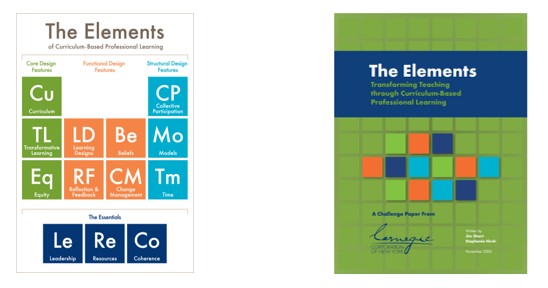
Of course, achieving the paper’s goal of strengthening professional learning required getting the report into the hands of teachers, coaches, and especially education leaders. We built a communications strategy that engaged our grantees as ambassadors to promote the paper through their digital platforms and via webinars they hosted with the authors. We also identified a core message to anchor our communications campaign, emphasizing the gap between the rigorous, inquiry-based instruction we expect teachers to deliver and the kinds of learning those adults experienced when they were students themselves. Curriculum-based professional learning allows teachers to experience firsthand the kind of instruction they should be providing to students while grounding that experience in the actual materials they’d be using in their classrooms.
A key component of our communications strategy was partnering with Learning Forward, the nation’s leading professional learning association. We sponsored a Learning Forward webinar that drew 1,800 registrants and more than 600 attendees, all of whom were also added to our education e-mail list for the future. We presented the report at Learning Forward’s annual conference in December 2020 and again the following year. We later sponsored the bundling of printed reports with Learning Forward’s magazine, which were mailed directly to the organization’s members.
All of these efforts led to positive reviews and word-of-mouth endorsements for the publication. Within months, the authors were being invited to speak about The Elements at conferences before audiences of school and system leaders, professional learning providers, and even the United States Department of Education. More than 4,000 copies of the report were downloaded during the first six months after publication and more than 6,000 copies have been downloaded in the 18 months after initial release. An additional 4,000 print copies have been distributed, and the report was recently expanded into a book by a leading education publisher.
In perhaps the clearest evidence of impact, the report’s recommendations have been embraced by multiple school districts, including one of the nation’s largest: Chicago Public Schools (CPS). Working with Learning Forward and several grantees featured in the paper, Jim and Stephanie led a series of workshops focusing on the elements, and CPS deployed its guidance to support implementation of the district’s new Skyline curriculum, benefitting hundreds of thousands of students annually.
 DEBRA WEXLER