
When I arrived at Hunter College in spring 2018, one of the most pressing priorities was a total overhaul of the college website, which had not been updated since 2010. The existing website was built using an arcane CMS that offered limited flexibility to incorporate popular features like photo carousels and embedded videos. The site was also not mobile friendly, a major liability for any organization these days, but especially one that heavily engages with young people.
The challenge for Hunter is that its website is really a universe of microsites — more than 150 of them — managed by staff across the College’s many schools and programs. To address that, we decided to redesign and migrate the site in stages, beginning with the landing page and about section of the site. We wanted to keep much of the content from the old site, which focused on news and events, but we also wanted to add “gateway” messaging for the College’s major audiences: current and prospective students; faculty and staff; alumni and supporters; and the broad public. Additionally, we wanted to make the page more visually engaging and modern, a sea change from the old site, which was almost exclusively comprised of links as seen in the screencap below.
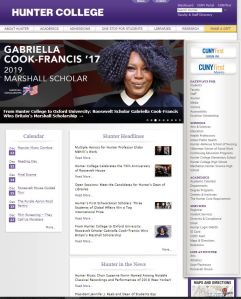
The result was transformational. The new landing page is vibrant and engaging, with a navigation structure that allows visitors to quickly find their way to the information they seek. Bold buttons provide a clear call to action around Hunter’s institutional priorities, such as applying to the college and encouraging donations. Faculty and student achievements get the spotlight they deserve, and new features celebrate major milestones toward achieving Hunter’s core strategic initiatives.
The redesign makes it easy to target specific content to key audiences. As news stories are gradually migrated onto WordPress, custom news feeds will make it possible to populate selected stories into different sections of the site by simply checking a box on the back end. A similar approach has already enabled the creation of tailored event feeds spotlighting key dates and programs of interests for discrete audiences. This ensures that the content on the website will always be fresh and relevant for visitors.
As the rest of the site is migrated onto the new platform, the Communications team can partner with faculty and staff to efficiently build pages using the new template and incorporating selections from a wide array of modules that meet their unique needs. For example, when we sat down with colleagues to discuss building a new section of the site dedicated to the College’s “All In East Harlem” initative, they wanted to be able to showcase the scale of its impact, to highlight major “wins,” and to create an archive of current and past projects. We proposed a landing page that features an eye-catching statistics bar and photo carousel to achieve the first two objectives, with secondary pages spotlighting the initiative’s most significant projects and cataloging the full range of programs that they have worked on since the initiative was launched three years ago. The entire process — from needs assessment, to design, to build — took only weeks to complete.

While much work lies ahead, the site provides a strong foundation to execute that work efficiently and to equip website managers throughout the College to maintain their pages and easily add “bells and whistles” as new content is available.
 DEBRA WEXLER